Recently I was dining with a certain friend acquaintance of mine, who, out of respect for her privacy, I shall only refer to as “Amy Jane S.” – or better yet, “A. Schrader.” As we sucked down margaritas and enjoyed delicious Mexican food, the conversation meandered between the relative superiority of my cell phone and the mass-energy equivalence as a consequence of special relativity. Eventually, I casually mentioned that I’d recently purchased a KitchenAid. Instead of simply congratulating me, or expressing the modicum of cheerful enthusiasm as required by friends acquaintances, she asked “What kind?”
“Black,” I replied, winking coquettishly at a passing woman who turned out, on closer inspection, to actually be a man.
“No, I mean what kind.”
“A regular KitchenAid,” I said. She didn’t get it. “A KitchenAid mixer. It mixes shit. It does mixing!”
“You do know that KitchenAid is a company, not a product?” she said, licking her thumb in a very unladylike manner.
“You do know that they are primarily known for one product, don’t you?” I replied.
Thus began one of the angriest and most drawn-out arguments of our friendship acquaintanceship. For the next forty minutes we pounded tequila and screamed at each other, I’m sure to the general horror of the tables surrounding us. Periodically, the conversation strayed into colorful invectives, judicious metaphors, and precisely calculated profanity, However, interspersed throughout the ad hominem attacks, I slowly and inexorably built my case until she was struggling in the overwhelming grasp of pure unadulterated logic and reason.
And, probably because she’s been living under a rock for twenty years, she simply refused to accept it.
My point, which is unassailable and correct, was simple. It is true, of course, that KitchenAid makes more than simply mixers, they make a variety of household products. However, certain companies have a signature product that they are known for, and before long the name of that company (to the dismay of their trademark lawyers) is synonymous with the product itself. It is at that point the average consumer can begin using the name to refer to the product itself and have a reasonable expectation that the average layperson would understand what they are talking about.
Take Kleenex, for example. Kleenex makes, among other things, hand towels, dinner napkins, and moist towelettes. However, if I were to say “I need a Kleenex” it is generally known in first-world countries that I need a facial tissue, Kleenex brand or otherwise.
Taking it one step further, if I said to a friend “I bought a Glock” they would naturally assume I had purchased a handgun. In addition to handguns, Glock makes gun cleaning kits, gun accessories, holsters, tactical lights, shovels, carrying bags, and more. This does not make my statement “I bought a Glock” need clarifying. If I had bought a Glock shovel, I would have specified that.
To really belabor my point, if I said I bought a Rolls-Royce, people would assume I meant a car, despite Rolls-Royce making engines for all sorts of machinery and aircraft, among other things.
So let’s see here.
I search Amazon.com for KitchenAid:
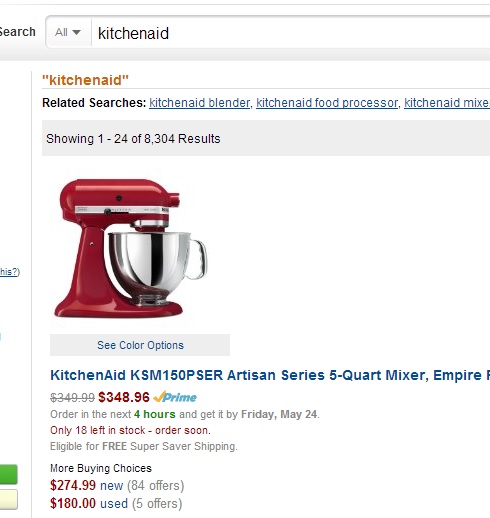
Oh look, number 1 result.
I search Google images:

Oh look, 15 out of the first 16 responses for a KitchenAid MIXER.
Hell, let’s check Wikipedia. Well, it looks like the company was formed in 1919 to make KitchenAid stand mixers and spent the next SIXTY YEARS DOING EXACTLY NOTHING BUT THAT before slowly starting to branch out into other appliances.
Let’s face it, Amy Jane S. – I mean, A. Schrader. I win. You lose. End of story.
I’ll expect your written notarized apology.

 joe writes
Leave a reply to Gregory M Anderson Cancel reply